
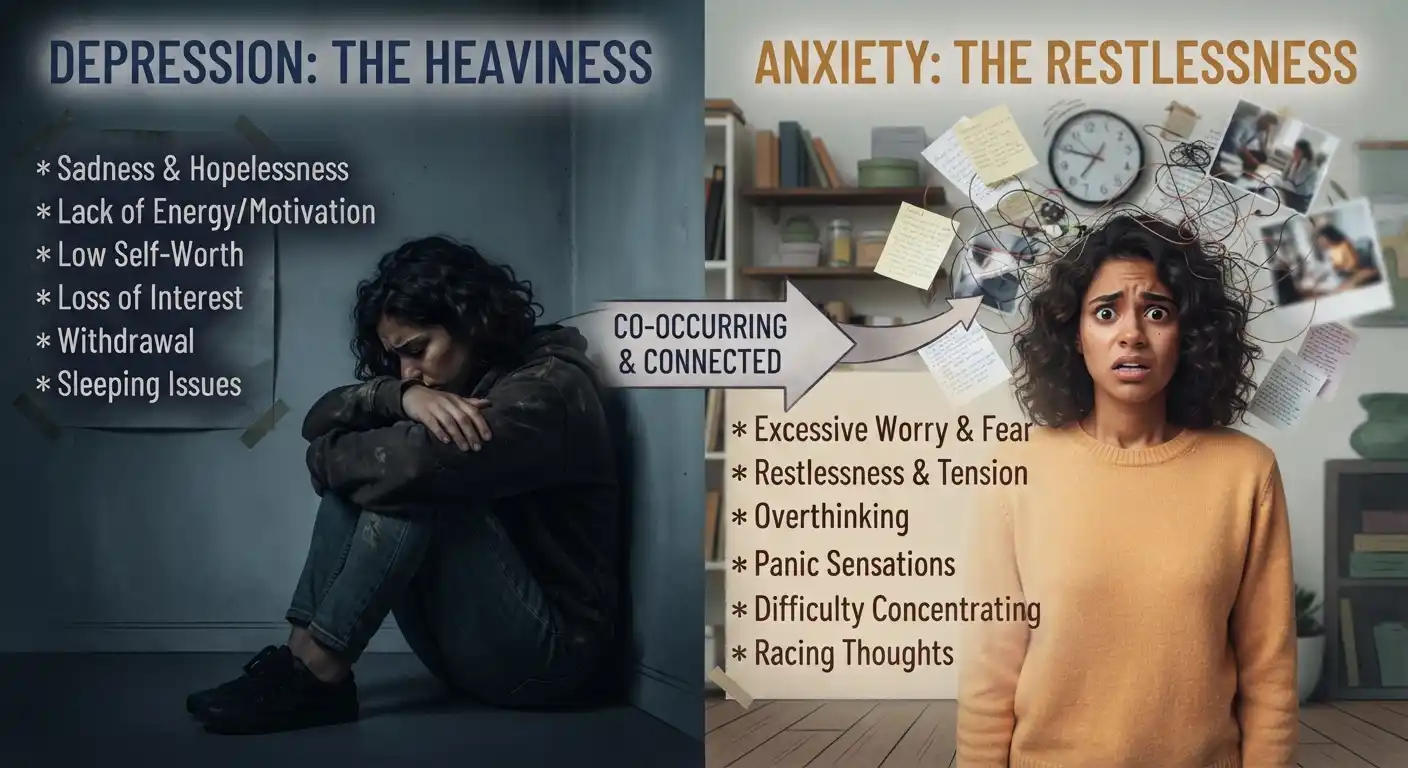

Depression vs anxiety treatment looks different depending on which symptoms are running the show in your daily life. Some days it feels like both. Some days one clearly leads. Knowing which pattern fits you is the first real step toward a treatment plan that works, instead of one that just sounds right on paper.
Depression and anxiety are the two most common mood disorders, and they often show up together. But they are not the same experience, and they do not always respond to the same first treatment step. This guide walks through how each one shows up, how to spot your own pattern, and what treatment path tends to fit that pattern best.
You do not need a clinical background to use this. You just need an honest look at your own symptoms. A licensed provider will confirm the details later through a full psychiatric evaluation. This is simply a clearer starting point.
Think of it as a map, not a diagnosis. Once you see where your symptoms fall, the conversation with a provider becomes far more focused, and the treatment plan that follows fits your actual experience instead of a generic label.
Depression and Anxiety Are Not the Same Experience
Depression tends to slow everything down. Energy drops. Motivation fades. Getting out of bed can feel like climbing a hill. Thoughts turn heavy, self-critical, and hard to shake. A person with major depressive disorder may lose interest in things they used to enjoy, sleep too much or too little, and feel a persistent sadness that does not lift on its own.
Anxiety tends to speed everything up. The mind races. The body stays tense, even when nothing is technically wrong. Generalized anxiety disorder brings excessive worry that is hard to control, along with restlessness, irritability, and a sense that something bad is about to happen. Panic attacks, a racing heart, and tight breathing are common physical signs.
Both conditions affect sleep, concentration, relationships, and work. Both respond well to therapy and medication. But the internal experience, and often the first treatment approach, is different depending on which one is driving your symptoms.
Depression vs Anxiety: A Quick Comparison
Here is a simple side-by-side look at how the two patterns typically show up.
| Symptom Pattern | Depression Dominant | Anxiety Dominant |
| Mood | Low, flat, or empty most of the day | Tense, on edge, or restless |
| Energy | Drained, hard to start tasks | Wired, racing, hard to sit still |
| Thoughts | Hopeless, self-critical, slow | Racing worry, worst-case scenarios |
| Sleep | Oversleeping or waking unrested | Trouble falling asleep, mind won’t stop |
| Body | Heavy limbs, appetite changes | Racing heart, tight chest, sweating |
| Triggers | Loss, isolation, ongoing stress | Uncertainty, performance, health worry |
Many people recognize themselves in both columns. That overlap is common, not unusual, and it changes how treatment is approached.
Find Your Pattern
If Depression Symptoms Lead
Persistent low mood, low energy, and a loss of interest in things you used to enjoy are the main signals. Sleep and appetite have shifted. Getting through an ordinary day feels heavy rather than urgent or panicked.
This pattern usually responds well to a combination of talk therapy and, when needed, an antidepressant such as an SSRI or SNRI. Cognitive behavioral therapy, which targets negative thinking patterns, tends to help most. A structured routine that rebuilds daily activity also supports recovery. Full details on medication management and therapy options for major depressive disorder are covered on our dedicated treatment page.
If Anxiety Symptoms Lead
Excessive worry, restlessness, and a body that will not settle are the main signals. Sleep is disrupted by a racing mind rather than low energy. Panic attacks, muscle tension, or a constant sense of dread may show up during the day.
This pattern often responds well to exposure-based therapy and skills that calm an overactive nervous system. Medication is added when symptoms are intense, persistent, or interfere with daily functioning. Full detail on treatment for generalized anxiety disorder and panic disorder is available on our service pages.
If Both Are Present
Low mood and high anxiety together are common, especially when chronic stress has been building for a while. In this case, treatment usually starts with the symptom causing the most disruption, then addresses the others alongside it. A combined therapy and medication plan, built around a full psychiatric evaluation, tends to work better than treating each condition separately.
Why the Right Starting Point Matters
Starting with the wrong approach costs time you do not need to lose. Someone whose anxiety is driving sleepless, racing nights may not get much benefit from an approach designed for low energy and motivation. Someone whose depression is rooted in fatigue and hopelessness may not respond well to strategies built mainly for panic and worry.
A psychiatric evaluation sorts this out early. It looks at your specific symptom pattern, personal history, and how daily life is affected, then points to a treatment plan tailored to what is actually happening, not a generic protocol pulled from a checklist.
Co-occurring depression and anxiety also need careful attention. Chronic stress can worsen both conditions at once, and treating only one often leaves the other untreated. A clear diagnosis from a mental health provider is what makes an accurate treatment plan possible.
Getting a Proper Diagnosis
A psychiatric evaluation is more than a symptom checklist. It looks at how long symptoms have lasted, how severe they are, what triggers them, and how they affect work, relationships, and physical health. It also rules out other conditions that can mimic depression or anxiety, including thyroid issues, sleep disorders, or medication side effects.
At Peniel Psychiatry in Texas and California, evaluations are handled by Kenny Adedayo, PMHNP-BC, a board-certified psychiatric mental health nurse practitioner with more than 12 years of nursing experience. She works with adults ages 18 to 65, treating depression, anxiety, bipolar disorder, ADHD, PTSD, and related conditions through a patient-centered, evidence-based approach.
What Treatment Looks Like at Peniel Psychiatry
Once your pattern is clearer, the next step is a full evaluation with a licensed provider. From there, treatment usually combines therapy, medication when appropriate, and lifestyle adjustments that support both. For people who do not respond fully to standard treatment, options like TMS therapy or ketamine treatment may be considered under close medical supervision.

online psychiatric care appointments are also available, so care fits into a busy schedule without requiring an office visit for every session. Our team walks through the entire process during your first visit, so nothing about starting treatment feels like guesswork.
Lifestyle Factors That Support Both Conditions
Certain daily habits support recovery no matter which pattern fits you. Regular exercise boosts serotonin and endorphin levels, which help improve mood and reduce anxious energy. Consistent sleep routines matter for both conditions, since poor sleep tends to worsen depression and anxiety alike. Balanced nutrition supports brain function, and reducing caffeine or alcohol can ease physical anxiety symptoms.
Mindfulness practices, journaling, and stress management techniques give the nervous system a chance to reset. None of these replace professional treatment, but they make therapy and medication work better when used alongside a real treatment plan.
Frequently Asked Questions
Can I have both depression and anxiety at the same time?
Yes. Co-occurring depression and anxiety are common. Treatment addresses both together rather than one at a time, guided by a full psychiatric evaluation.
Do depression and anxiety need different medications?
Sometimes the same medication class treats both conditions. Other times a provider adjusts the plan based on which symptoms are strongest. This decision is made on a case-by-case basis, not by a fixed rule.
How do I know which one I am dealing with?
The comparison above is a starting point, not a diagnosis. A psychiatric evaluation gives a clear answer based on your specific symptoms, history, and daily impact.
Is therapy or medication the better first step?
It depends on symptom severity and pattern. Mild to moderate symptoms often start with therapy alone. More intense or long-running symptoms often benefit from therapy and medication together from the start.
How long does treatment usually take to show results?
Therapy often shows early progress within a few weeks, while medication can take four to six weeks to reach full effect. Ongoing check-ins help track progress and adjust the plan as needed.
Getting Started
If you recognize your pattern in what you read here, the next step is a conversation with a licensed provider. Peniel Psychiatry offers evaluations and ongoing care for depression, anxiety, and co-occurring conditions, with a treatment plan built around your specific symptoms rather than a one-size-fits-all approach. Schedule a consultation to take that next step toward feeling steady again.